
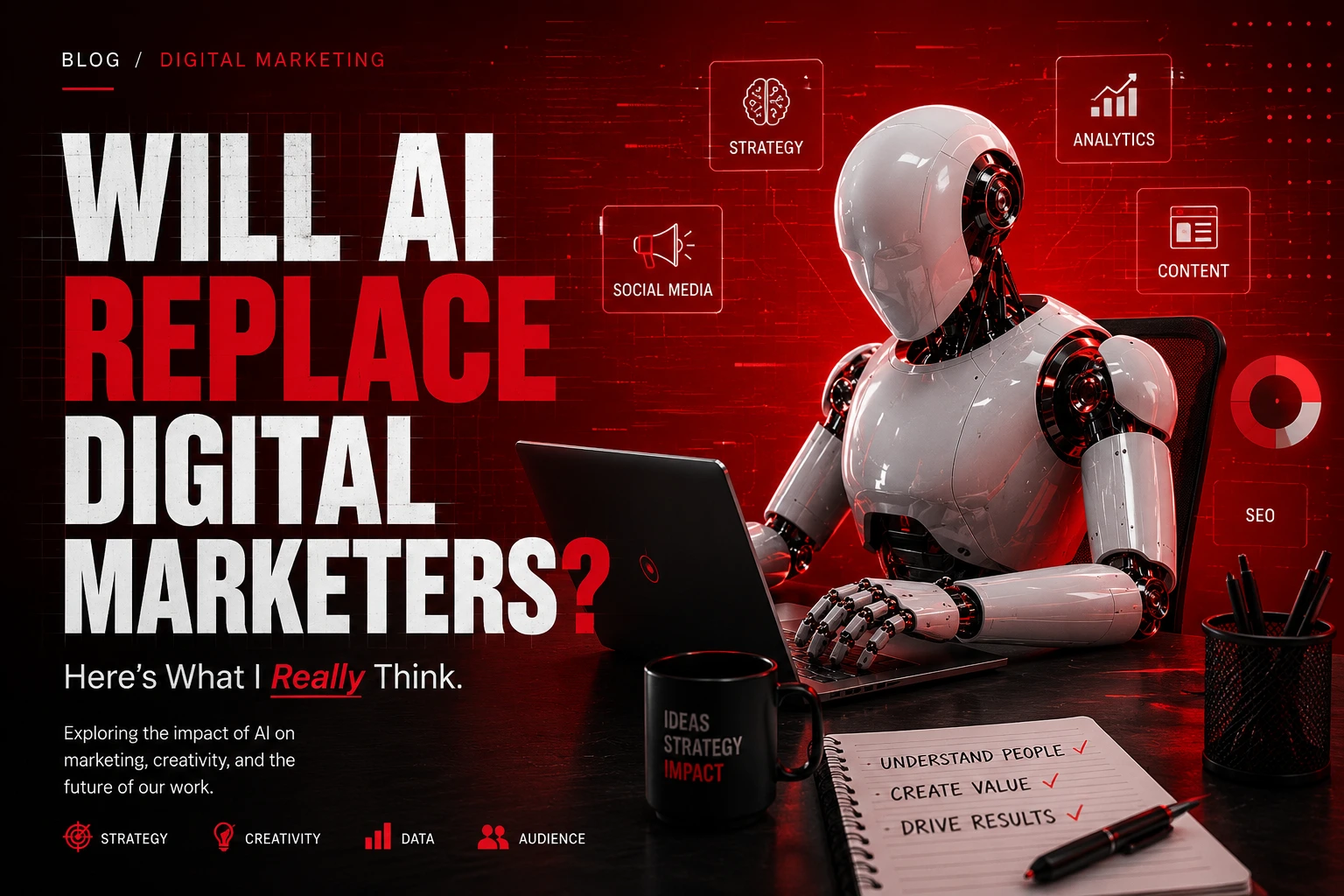
AI is changing the way we work. That’s probably something most of us have noticed by now.
A few years ago, creating an advertisement could mean writing the copy, designing the visual, researching the audience and spending hours putting everything together. Today, AI can help with almost every one of those tasks in a matter of minutes.
It can generate ideas, write copy, create images, analyse data, suggest keywords and even help plan campaigns.
And that naturally raises a question for anyone working in marketing:
Will AI replace digital marketers?
I don’t think the answer is as simple as yes or no.
AI is already changing digital marketing
You don’t have to look very far to see the impact.
Marketers are already using AI to brainstorm campaign ideas, create different versions of ads, research topics, summarise information and speed up repetitive work.
Things that once took hours can sometimes be done in minutes.
And I don’t necessarily see that as a bad thing.
If a tool can handle some of the repetitive work, it gives marketers more time to think about the things that actually make a campaign work — the idea, the audience, the message and the strategy behind it.
But there’s an important difference between doing a task and understanding why you’re doing it.
That difference matters.
AI can create an ad. But can it understand the brand?
Imagine you own a small café.
You ask an AI tool to create an Instagram ad. Within seconds, it can probably give you a decent headline, a polished image and a caption to go with it.
Useful? Definitely.
But does it really know why people choose your café instead of the one down the road?
Maybe people come because the owner remembers their usual order. Maybe it’s where college students spend their evenings. Maybe customers love the slightly chaotic atmosphere that would never appear in a traditional brand guideline.
Those little details are often what make a business feel like itself.
Good marketing needs to find those details and turn them into something people can connect with.
That takes more than generating content.
It takes understanding people.
Having more ideas doesn’t always mean having better ideas
AI is getting incredibly good at generating visuals, copy and concepts.
Give it the right prompt and you can have 20 campaign ideas before you’ve finished your coffee.
But then comes the difficult part.
Which one is actually good?
Which idea feels right for the brand? Which one communicates the message without trying too hard? Which one looks different from the hundreds of posts someone has already scrolled past today?
And sometimes, which idea should simply be thrown away?
Generating options is becoming easier.
Knowing which option is worth pursuing is still a skill.
That’s where creative judgment, experience and taste become much more important.
AI can give you possibilities. Someone still has to decide what to do with them.
What about SEO and data?
This is where I think AI will have an even bigger impact.
SEO involves a lot of research, analysis and repetitive work. AI tools can already help identify search trends, organise information, find content opportunities and make sense of large amounts of data much faster.
Advertising is similar.
Platforms can analyse campaigns, optimise targeting and find patterns that might take a person much longer to notice manually.
But numbers don’t always give you the answer.
Imagine your website traffic suddenly increases by 40%, but enquiries actually go down.
On paper, more traffic sounds great.
In reality, something clearly isn’t working.
Maybe the wrong audience is reaching the website. Maybe the landing page isn’t convincing enough. Maybe the offer isn’t clear. Or maybe people simply aren’t finding what they expected when they clicked.
A dashboard can show you what happened.
A good marketer needs to figure out why it happened and what to do next.
That difference is important.
So, will AI replace digital marketers?
Some tasks? Almost certainly.
Some roles may change significantly too.
We’re already seeing repetitive parts of marketing becoming faster and more automated, and pretending that won’t affect jobs would be unrealistic.
But I don’t think good marketers are simply going to disappear.
I think the job itself is going to change.
Instead of manually creating every piece of content, marketers may spend more time deciding what should be created in the first place.
Less time doing repetitive work.
More time thinking about strategy.
More time understanding customers.
More time testing ideas and learning from what works.
And probably a lot more time working alongside AI.
The bigger risk might not be AI
There’s another way to look at all of this.
The biggest risk for marketers might not be AI replacing them.
It could be marketers who know how to use AI replacing those who don’t.
Imagine two people with similar marketing skills.
One spends three hours researching a campaign manually. The other uses AI to organise the initial research in 20 minutes, checks the information, adds their own understanding and spends the remaining time improving the strategy.
Who has the advantage?
Probably the second person.
That’s why completely avoiding AI doesn’t make much sense to me.
Learning how to use it does.
But relying on it for everything creates another problem.
If every brand uses the same tools, follows the same prompts and accepts the first idea that appears on the screen, we’ll eventually end up with a lot of marketing that technically looks good but feels strangely familiar.
Same captions.
Same visuals.
Same ideas.
Different logos.
And being forgettable is probably one of the worst things a brand can become.
What should marketers focus on now?
I think the most valuable marketing skills are becoming less about knowing where every button is inside a particular platform.
Platforms change.
Algorithms change.
Tools change.
What matters more is understanding what sits underneath all of them.
People.
Why does someone choose one brand over another?
Why does one advertisement make you stop scrolling while another disappears into the feed?
Why do people remember certain brands for years?
Why does a campaign that looks perfect sometimes completely fail?
Those questions involve psychology, communication, branding, creativity, data and business thinking.
Knowing Photoshop, SEO, Meta Ads or Google Ads is useful.
Knowing why to use them, when they make sense and how they fit into a larger strategy is much more valuable.
The future probably isn’t humans vs AI
I don’t think the future of digital marketing will be a competition between people and machines.
It’ll probably be much less dramatic than that.
AI will become another part of the marketer’s toolkit — just a very powerful one.
It will handle more repetitive work, help analyse information faster and make creating and testing ideas easier.
But someone still needs to understand the customer.
Someone still needs to understand the business.
And someone still needs to decide what’s actually worth saying.
So, will AI replace digital marketers?
For some tasks, yes. For the profession as a whole, I don’t think so.
The marketers who adapt will probably spend less time doing work that can be automated and more time doing the work that requires judgment, creativity and an understanding of people.
The tools will keep changing. They always have.
But the reason good marketing works hasn’t changed nearly as much.
AI might change how we do marketing. It doesn’t necessarily change why good marketing works.